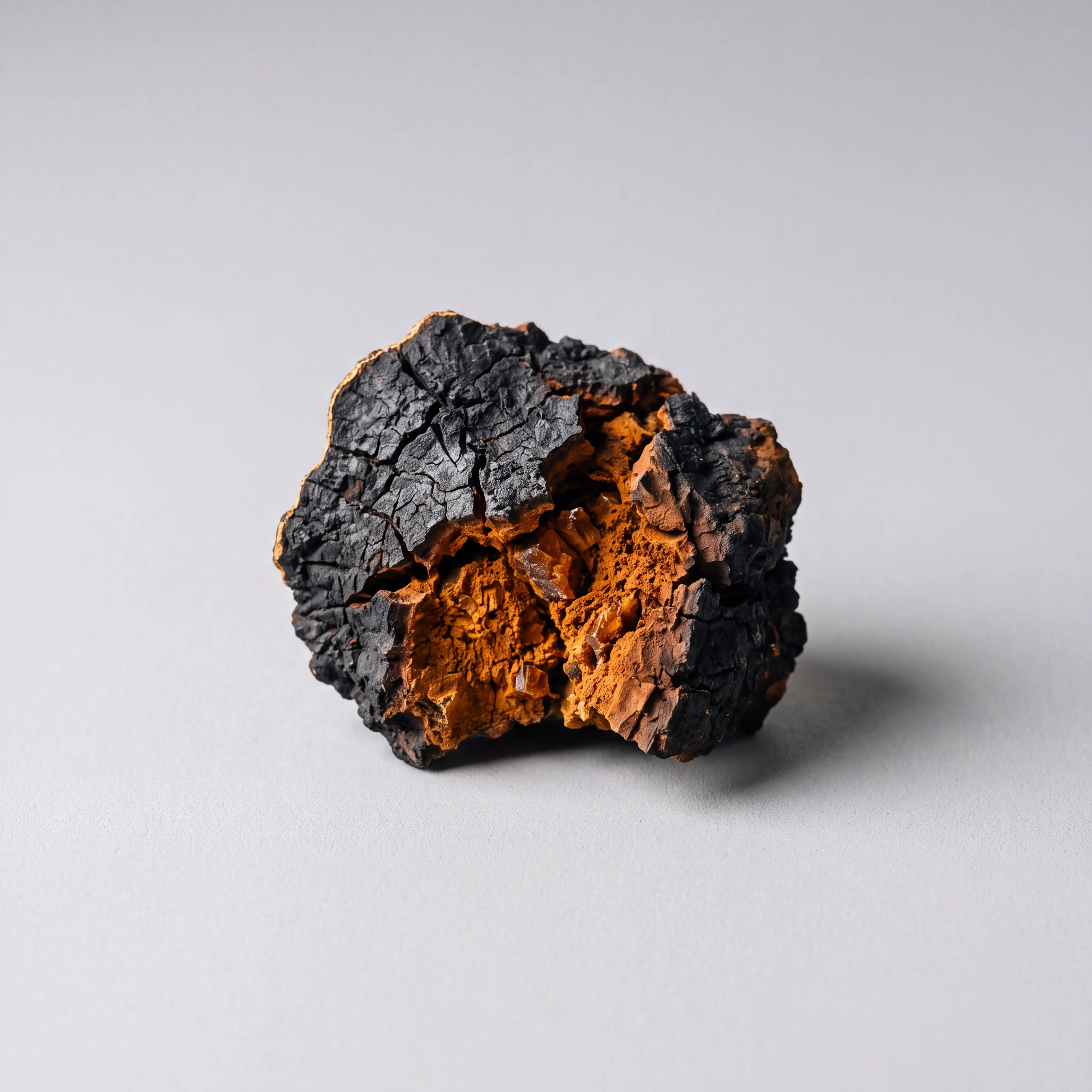
Chaga (Inonotus obliquus) doesn't look like a mushroom at all. It erupts from the trunks of birch trees as a cracked, charcoal-black conk — the outside like burnt bark, the inside the color of rust and amber. It grows slowly, over years, in the coldest forests of the northern hemisphere: Siberia, Scandinavia, Canada, the northern United States.
Where it grows, people have always brewed it. Siberian and northern European folk traditions ground Chaga into teas centuries before anyone could say why; in parts of Russia it simply was the coffee of the woods.
What the research looks at
Chaga's black crust is dense with melanin, and its interior with polyphenols, beta-glucans and betulinic-acid derivatives absorbed from the birch it grows on. Measured by common antioxidant assays (like ORAC), Chaga extracts score among the highest of any natural material tested.
What that means for a human being is studied, not settled: antioxidant capacity in a test tube does not automatically translate to outcomes in a body. The fair reading is that Chaga is a traditional boreal tea ingredient with an unusually rich phenolic profile that researchers consider worth investigating — oxidative-stress models are where most of the work happens.
Why it's in the bar
Chaga brings the earthiest note of the four — faintly roasted, almost coffee-like — which is why it disappears so gracefully into dark chocolate. It is the bar's low end: the bass note under Lion's Mane's clarity and Reishi's calm.
The bass note of the bar — boreal, roasted, patient.
Common questions
Is Chaga psychoactive?
No. Chaga (Inonotus obliquus) contains no psilocybin and no intoxicating compounds. It is a traditional tea fungus taken as food. LORE bars are functional and non-psychoactive.
What is Chaga good for?
Chaga is studied for its antioxidant profile — melanin, polyphenols and betulinic-acid derivatives from the birch it grows on. Extracts score highly on laboratory antioxidant assays, and research explores oxidative-stress models. Human evidence is early; it is a studied traditional food, not a proven treatment.
What does Chaga taste like?
Brewed alone, like an earthy, slightly vanilla-edged coffee substitute. In a LORE square it reads as a roasted depth underneath the dark chocolate.
Is Chaga sustainable to harvest?
Wild Chaga grows slowly, so responsible sourcing matters. LORE uses organic, sustainability-audited extract suppliers rather than ad-hoc wild foraging.
These statements have not been evaluated by the Food and Drug Administration. LORE is a food, not a medicine — this article is for general information and is not medical advice. This product is not intended to diagnose, treat, cure, or prevent any disease.